There's a particular kind of quiet that settles in when you're a grandparent who lives 4 hours away. It's not silence, exactly. It's more like… distance you can feel. You know the birthdays, the school plays, the soccer games are all happening. You see the photos your daughter posts. You hit the heart button. You type "So proud of you!" in the comments.
But you weren't there.
And somewhere between the holiday visits and the summer weeks, the kids keep growing. Their voices change. Their interests shift. And the thing you dread most — more than the drive, more than the bad knees, more than any of it — is becoming the grandparent they only know from Christmas.
That's the quiet I'm talking about.
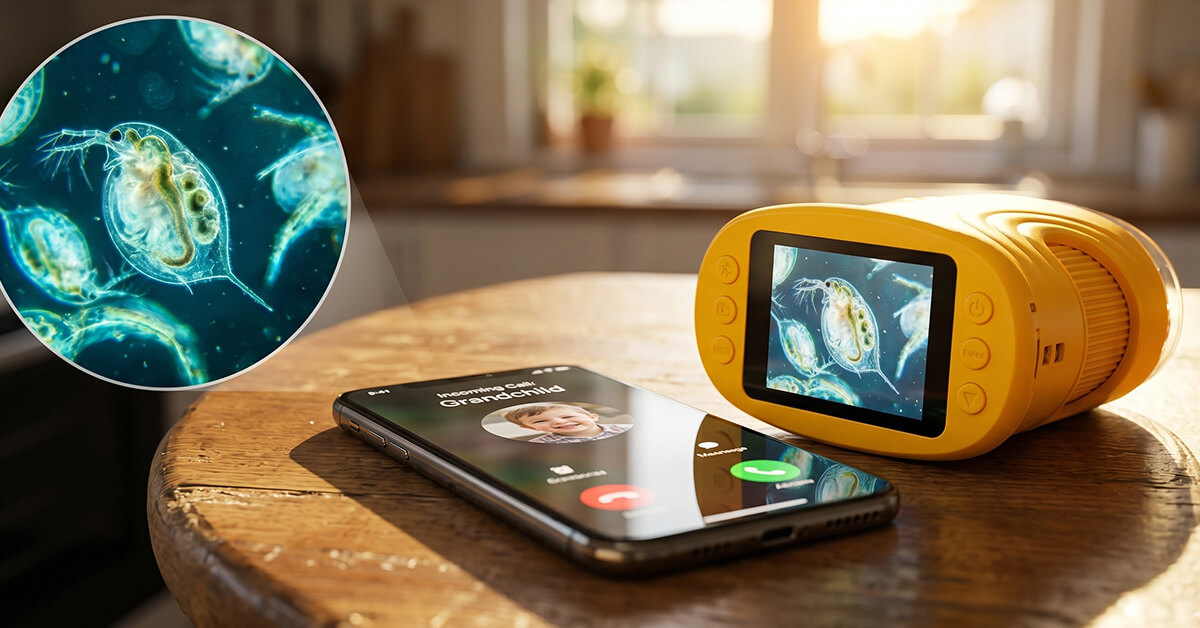
So when a 7-year-old girl called her grandfather on an ordinary Wednesday afternoon, completely unprompted, just to describe in breathless detail what she had found living inside a rain puddle on the back patio — that wasn't just a phone call.
That was everything.
The Visits Were Never Long Enough. Then Something Changed.
Jim and his granddaughter Ellie live in different states. He's in Pennsylvania. She's in North Carolina. They see each other maybe 5 times a year if the schedules cooperate, which they usually don't.
Jim is the kind of grandfather who wants to be useful. He doesn't just want to show up with a card and a gift bag. He wants to be the one who teaches her things. Shows her how the world works. Gives her something to carry with her long after he's gone.
But it's hard to be that person from 4 hours away.
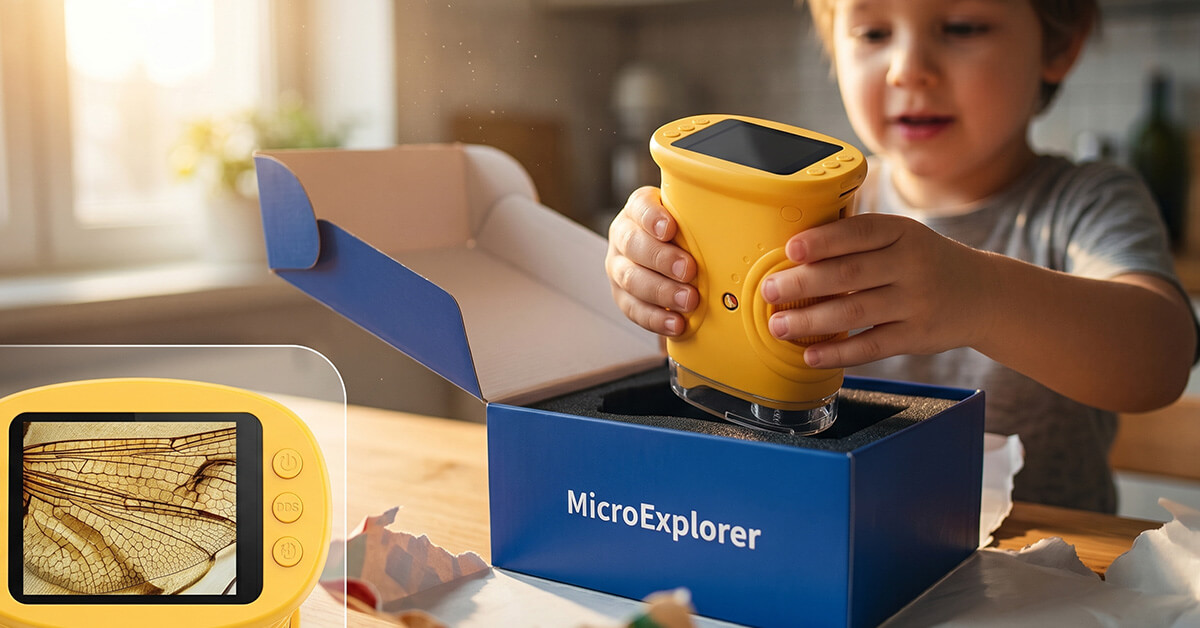
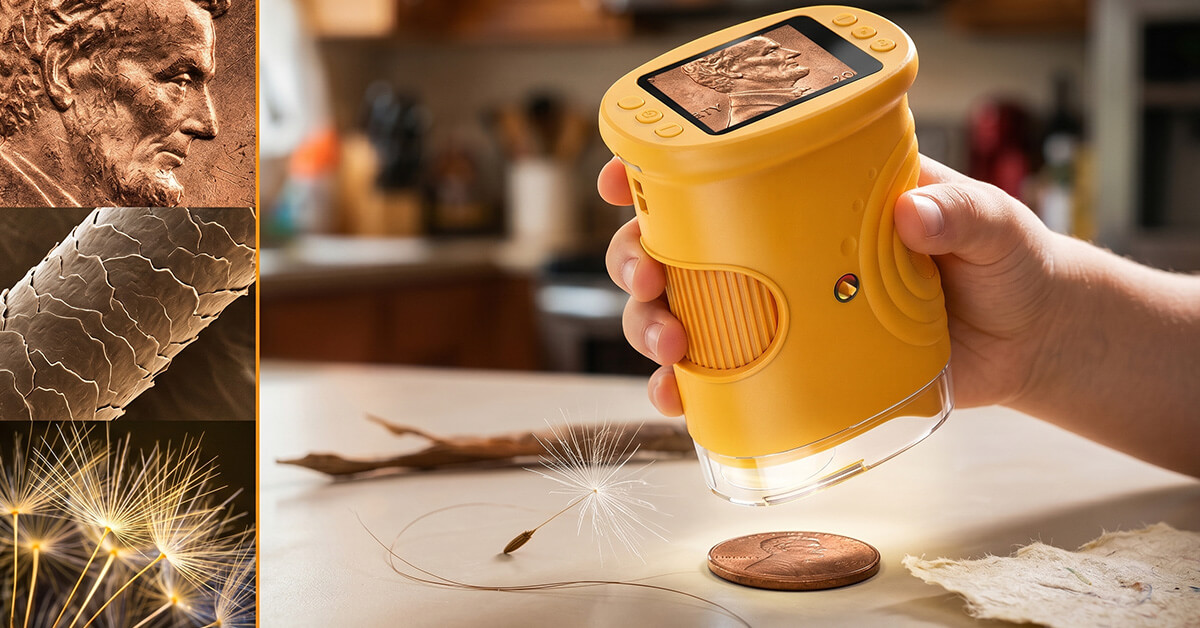
Last spring, Jim sent Ellie a MicroExplorer — a handheld 4K microscope that fits in a child's grip and magnifies anything from 200x to 1000x on a bright, built-in screen. No slides. No setup. No cords. Just point it at something and twist the zoom wheel.
He figured she'd play with it for a weekend and move on.
He was wrong.
A Puddle Became a Rainforest. A Cobweb Became an Engineering Marvel.
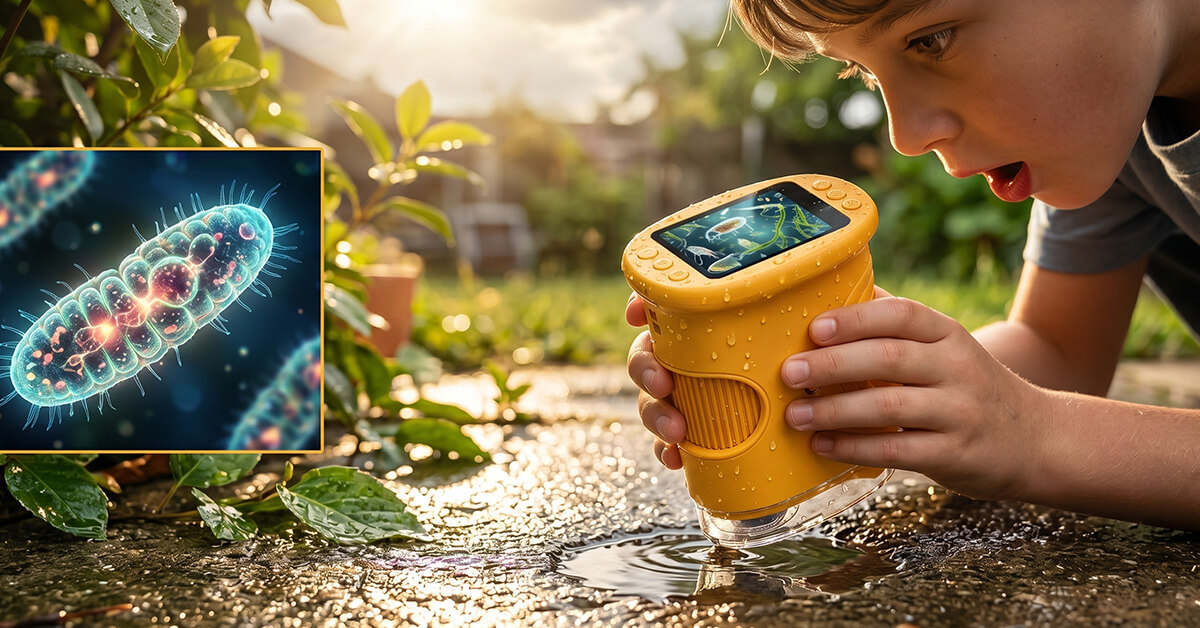
The first call came 3 days after the package arrived. Ellie had pointed the MicroExplorer at a drop of water from a puddle near the garage. What she saw on that little 4K screen made her scream.
Not a scared scream. A discovery scream.
There were things moving in there. Tiny, translucent, alive. She didn't know what they were. She didn't care what they were called — not yet. She just knew that Grandpa was the person who needed to see this.
So she called.
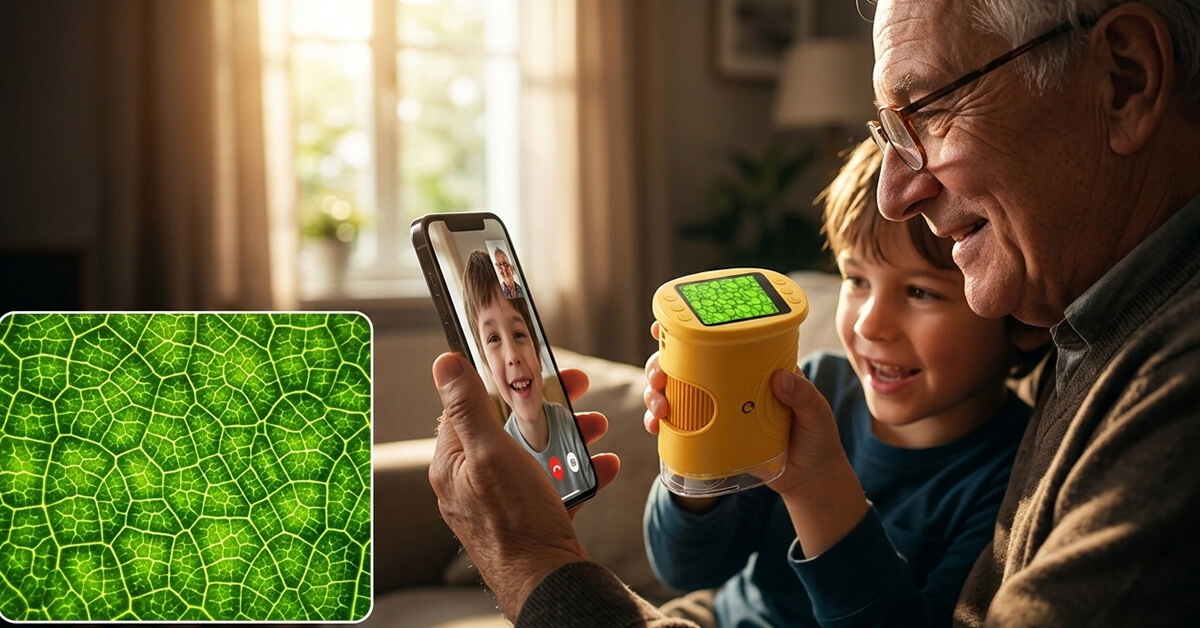
Jim listened for 12 straight minutes while she described every squirming, darting organism she could see. She held the phone up to the screen so he could watch. She asked him if he thought the big one was eating the little one. She wanted to know if puddles in Pennsylvania had the same creatures as puddles in North Carolina.
He didn't have all the answers. But he had the conversation. And that mattered more than any answer ever could.
Within 2 weeks, the calls became a rhythm. Not scheduled. Not forced. Just… natural. Ellie would find something — a dead beetle wing, a piece of bark, a strand of her mom's hair, a crumb of toast — and she'd zoom in with the MicroExplorer and capture a photo or video with one tap. Then she'd call Jim to show him.
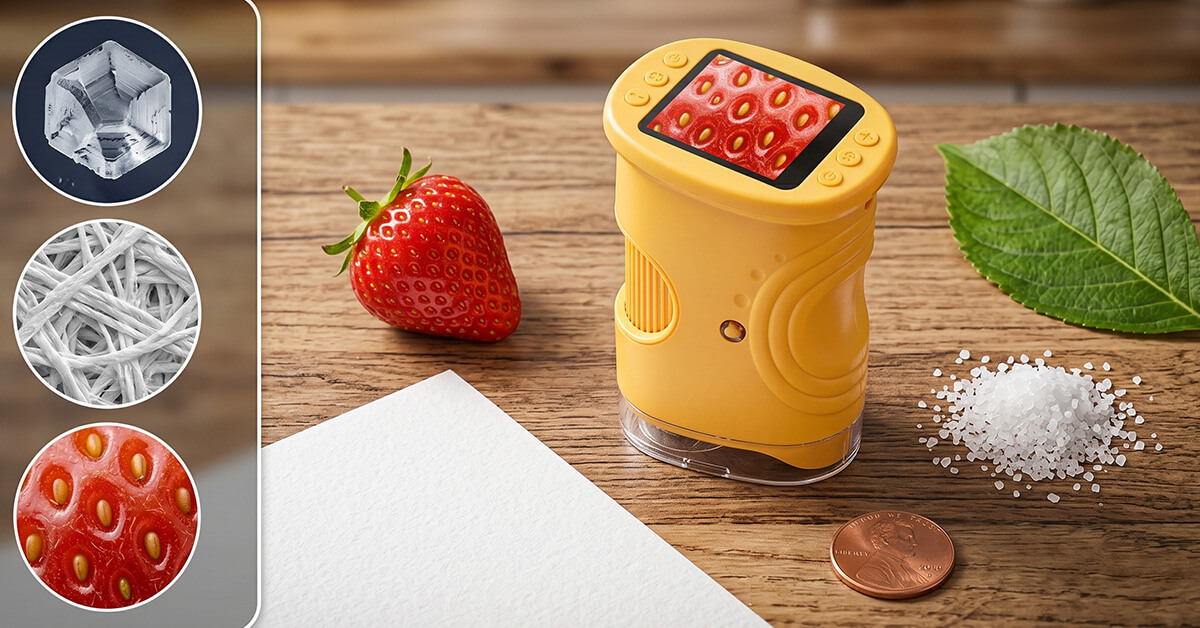
A cobweb became a lesson in structural engineering. A strawberry seed became a landscape from an alien planet. A grain of salt became a perfect, glittering cube that made them both go silent for a second, just staring.
Every single discovery was one more thread keeping 2 people close who geography was trying to pull apart.
Why This Works When Other Science Gifts Don't
Jim had tried before. He'd sent Ellie a chemistry set that required adult supervision for every step. A rock collection that sat in its box. A telescope that needed a clear night, a dark yard, and patience that no 7-year-old possesses at 10 PM.
Every one of those gifts meant well. None of them worked.
The MicroExplorer was different for one simple reason: it removed every barrier between a child and the moment of wonder.
There's no assembly. No instruction manual to decipher first. No adult required to prepare slides or mix solutions. The device powers on, the dual LED lights illuminate whatever surface it's pointed at, and the 4K screen shows what the naked eye could never see. The zoom wheel is smooth and satisfying. The grip is ergonomic — actually designed for smaller hands. And the drop-resistant build means it survives being carried through a backyard, dropped on a patio, or stuffed into a backpack alongside juice boxes and granola bars.
It goes where kids go. And because it goes where kids go, it gets used. Not once. Not for a weekend project. Constantly.
That's the part the fancy science kits never figured out. You can't schedule curiosity. You can't assign wonder as homework. You have to make the tool so easy and so immediately rewarding that a child reaches for it the way they reach for a favorite toy — instinctively, repeatedly, without being asked.
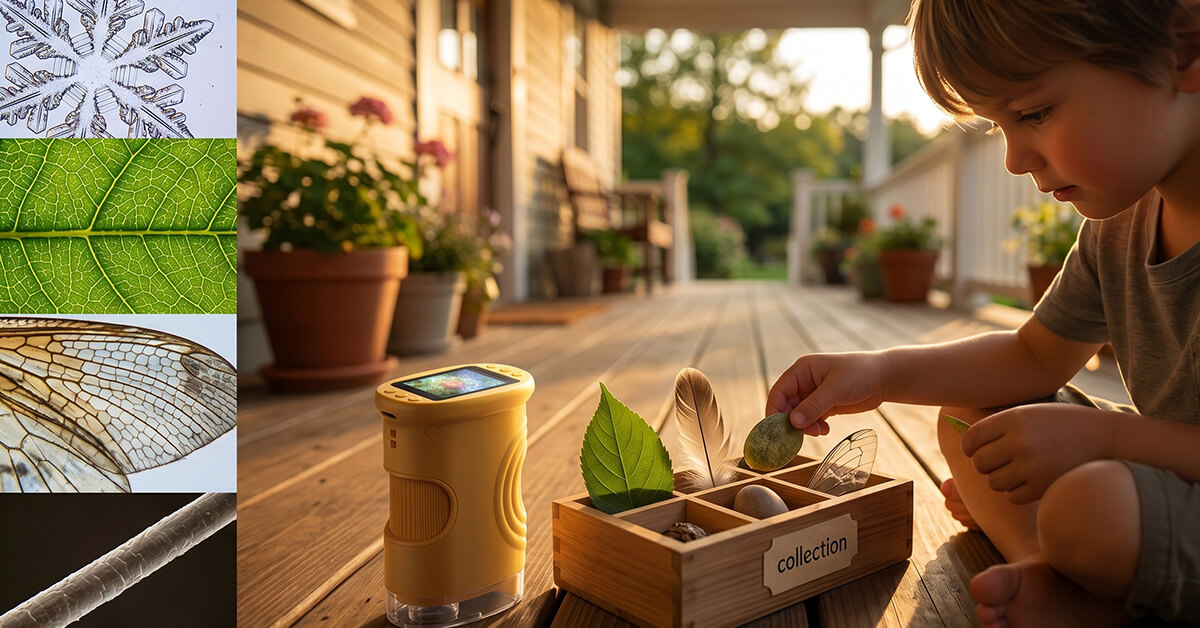
Ellie keeps hers on the kitchen counter now, next to the fruit bowl. Her mom says she picks it up at least 3 or 4 times a week without being prompted. She zooms in on whatever catches her eye. And when she finds something extraordinary — which is often, because the microscopic world is endlessly extraordinary — she saves a photo and adds it to what she and Jim now call "The Collection."
The Collection has 87 images so far. Jim knows because he counts.
The Phone Calls Nobody Expected
Here is what Jim will tell you if you ask him about the MicroExplorer: he won't talk about the magnification range. He won't mention the 4K resolution or the battery life or the one-touch photo capture, even though all of those things work exactly as described.
He'll tell you about the phone calls.
He'll tell you about the Wednesday puddle call. About the Saturday morning when Ellie called because she had zoomed in on a butterfly wing and the colors looked "like a church window." About the time she found a tiny mite on a leaf and spent 20 minutes on the phone with Jim trying to figure out if it was a baby spider or something else entirely. (They Googled it together. It was a mite. They were both somehow delighted and disappointed at the same time.)
He'll tell you that his daughter — Ellie's mom — said something to him last month that he can't stop thinking about.
She said: "Dad, you're the first person Ellie wants to call when she finds something. Not her friends. Not me. You."
He had to hang up for a minute after that one.
This is what a great gift actually does. Not entertains. Not educates — although the MicroExplorer does both of those things effortlessly, building real STEM skills through genuine hands-on discovery. But the thing it does that nothing else in Jim's gift history has done is this:
It gave a 7-year-old a reason to pick up the phone and call her grandfather. Voluntarily. Repeatedly. With joy.
For a man who lives 4 hours away and has quietly worried about becoming a stranger to the person he loves most in the world — that's not a microscope.
That's a lifeline.
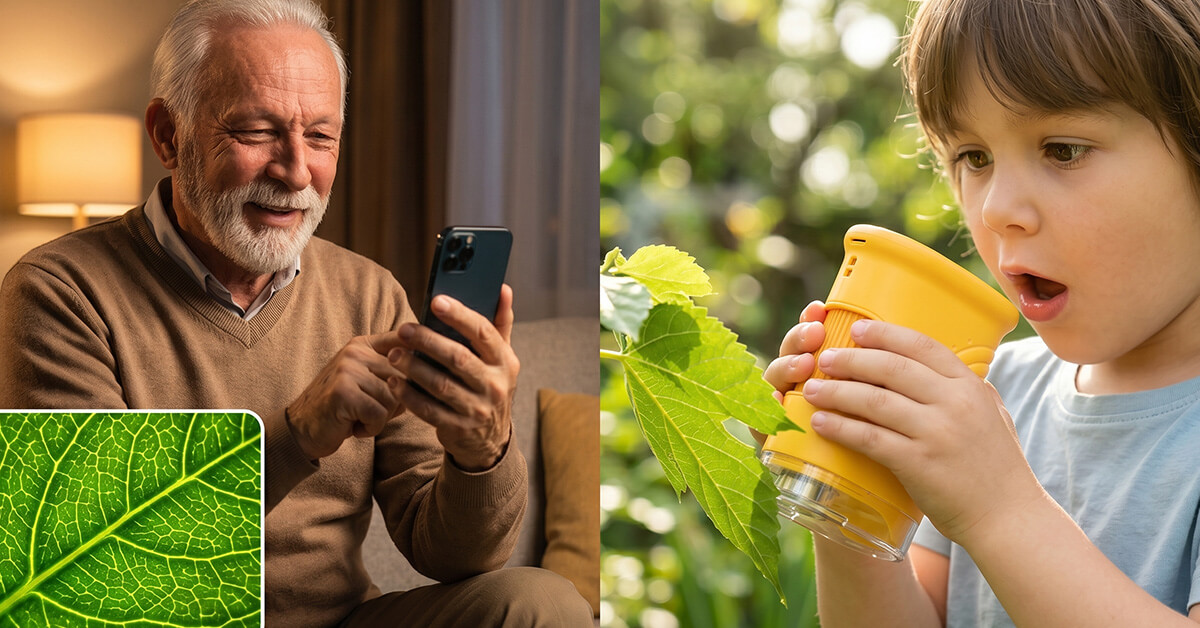
What Everyday Objects Look Like Through the MicroExplorer (and Why Kids Can't Stop Looking)
Part of what makes this work — what makes the calls keep coming — is that the microscopic world is genuinely, jaw-droppingly strange. Things that seem boring at normal scale become astonishing at 200x, 500x, or 1000x magnification.
Here's what Ellie has explored so far, according to The Collection:
A grain of table salt — looks like a perfectly carved ice cube from a miniature planet.
A strand of her own hair — shows overlapping scales, like roof shingles, that she didn't believe were real until Jim confirmed it.
A dandelion seed — the filaments look like crystal chandeliers, impossibly delicate and perfectly symmetrical.
A piece of notebook paper — not smooth at all. A tangled jungle of fibers, with tiny flecks of color woven in.
The skin on the back of her hand — ridges and valleys and what might be the opening of a pore, which prompted a 15-minute conversation about sweat glands that neither of them saw coming.
A penny from 1987 — the year Jim was born (he told her; she was impressed). Under magnification, the copper surface looked like a weathered canyon.
Every one of these objects was already in Ellie's house. Already within arm's reach. The MicroExplorer didn't require a field trip or a special specimen. It just required looking at what was already there — and seeing it for the first time.
That's the magic. The raw material for wonder is everywhere. It just needs the right lens.
For the Grandparent Who Wants to Be More Than a Name on a Card
This isn't a toy review. This is a recognition of something that doesn't get talked about enough.
Long-distance grandparenting is lonely. It's watching a child's life through a screen. It's birthday gifts that get a polite thank-you and then silence. It's wondering, during the long stretches between visits, whether you're fading from their daily world.
The MicroExplorer doesn't fix geography. It doesn't shorten the drive or add more vacation days to the calendar.
But it does something that might matter more: it creates a shared language. A running project. An excuse to call that doesn't feel like an obligation. When a child discovers something astonishing and her first instinct is to call you — not text, not post, call — that's connection you can feel in your chest.
1,840 verified reviews from families confirm what Jim already knows. This device works. It's durable enough for real kid adventures. The 4K screen is sharp and bright enough for aging eyes to enjoy on the other end of a video call. The photos it captures are clear enough to print and stick on a refrigerator 4 hours away.
And the zero-setup design means a child can use it independently, which means the discoveries — and the calls — come on their schedule, driven by their curiosity. Not a parent hovering. Not an instruction sheet dictating steps. Just a kid, a microscope, and the unfiltered urge to share what she found with someone who matters.
She's Already Planning What to Show Him at Thanksgiving
Ellie told her mom she's building a "special edition" of The Collection — discoveries she's saving specifically to show Jim in person when he drives down in November. She wants to put the MicroExplorer in his hands and watch his face when he sees a blade of grass at 1000x for the first time.
She's 7 years old, and she's planning 3 months ahead because she can't wait to share something with her grandfather.
Jim doesn't know about this yet.
But when he finds out, he's going to need a minute again.
Make This the Gift That Keeps the Phone Ringing
Right now, the MicroExplorer is available at half the regular price — a limited-time introductory offer for first-time buyers. No special codes to remember. No bundles to sort through. Just the device, ready to ship within 24 hours, protected by a 30-day money-back guarantee with no questions asked and no hoops to jump through.
If it doesn't spark the kind of discovery — and connection — described here, send it back. Every penny returned. Zero risk.
But if a phone rings on an ordinary Wednesday, and there's a small, excited voice on the other end saying "Grandpa, you have to see what I found" — then it will have been worth far more than any price on any screen.
Some gifts get opened and forgotten. A rare few change the way 2 people stay connected.
This is one of those.
[Order the MicroExplorer now at 50% off while the introductory offer lasts.]
Click the link above to see if MicroExplorer is still offering a 50% off discount.